There is One King

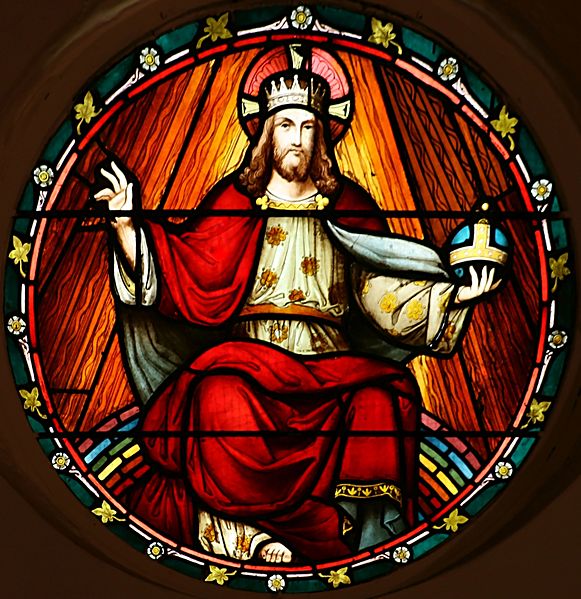
As today’s Feast of Christ the King draws to a close, let us remember that in the end, there is only one true King, one Victor. We cannot serve two masters. We must serve the King, our Savior, He who desires to reign in our hearts:

Salvator Mundi

Photo by Toby Hudson CC BY-SA 3.0 or GFDL, via Wikimedia Commons

“He is our king. He desires ardently to rule our hearts, because we are children of God. But we should not try to imagine a human sort of rule — Christ does not dominate or seek to impose himself, because he “has not come to be served but to serve.”

His kingdom is one of peace, of joy, of justice. Christ our king does not expect us to spend our time in abstract reasoning; he expects deeds, because “not everyone who says to me, Lord, Lord!, shall enter the kingdom of heaven; but he who does the will of my Father in heaven shall enter the kingdom of heaven.” -St. Josemaria Escriva

Let us then invite the King into our hearts, preparing the way for Advent, for His coming in the manger, and go out into the world to spread His message of love and truth in word and action. Pax.

On the Journey: Eudaimonia, Pears, and True Happiness

Augustine’s Confessions I.5-6

No one can part You from the things that You love, and safety is assured nowhere but in You.

What motivates our actions? I think it is safe to say that in almost all cases, human beings are driven to act by that which they see as good, that which will lead to happiness. Aristotle says “happiness depends on ourselves” and in a sense, I suppose that is true. In order to be happy, we must act, we must seek that which makes us happy. And what makes us happy? The good, true, and beautiful.

I remember when I first listened to Beethoven’s Missa Solemnis. It was at the recommendation of a dear friend and mentor, Fr. Paschal, God rest his soul. He gave me this advice before listening to it: “Don’t worry about anything else for an hour! Get a nice glass of wine, turn the music on, and just experience it!” Despite my busy academic schedule at the time, I did what he suggested, and it became a pivotal moment: the music moved me in a way that had never happened before. In that moment, I felt truly happy, allowing myself to be caught up in the movement of the work, to escape the worries of life, even if only for an hour. To borrow a literature term, it was truly a pastoral moment.

I was experiencing something that many of us encounter in our lives, in some fashion: there are things on this earth that make us truly happy and bring joy to our hearts. But while they make us happy, we must remember that the good, true, and beautiful leads to something else, something higher.  Augustine reminds us of this deep truth of human existence: we can find goodness in so many things of this world, such as beautiful objects, material things, friendship. For Aristotle, this quest for happiness was a quest for “eudaimonia“, pursuing health, wealth, and excellence to achieve the ultimate in human flourishing. Augustine, on the other hand, goes further: our quest for happiness must move to a much deeper, a much higher. level or we risk twisting even the good things in our lives into something that will bring us to ruin, rather than fulfillment.

What happens when this quest for happiness, or perhaps we can say now fulfillment, becomes twisted? This is where confusion and sin enter the picture. Sin, a turning in on oneself and away from God, is the disordered seeking of that which we think is good but in reality is not, or even seeking a good but through means that fracture our relationship with God and those around us. After all, even the worst atrocities in human history have been committed by people who thought they were doing good. We are wronged, so we commit revenge. We are envious, so we commit murder. We are lustful, so we commit adultery. At the center of these actions is a disordered desire to seek fulfillment: whether it is achieving some sort of excellence, wanting to battle what we perceive as an injustice, or seeking a relationship to fill an inner need to connect on an intimate level with another. In each of these situations, the individual is searching for what he or she thinks is good, but in the end, comes up empty.

In Augustine’s case, it was even worse! He steals a measly pear not because he needed it, or he thought it was better than the fruit he had. He stole it simply for the sheer desire of the sin:

For no sooner had I picked them than I threw them away, and tasted nothing in them but my own sin, which I relished and enjoyed. If any part of one of those pears passed my lips, it was the sin that gave its flavor.

PearBlossomsCalifornia

Pear blossoms from my native California. Who knew fruit could be so much trouble? Well, there was Eden…

Makes you feel a bit better, doesn’t it, knowing that even a Church Father, one of the greatest theologians and leaders in human history, was a lowly sinful person like the rest of us, huh?

St. Augustine was, in reality, seeking happiness, even if it was in a disordered way. This does not excuse the action, of course, don’t get me wrong, but he comes to the realization, praise God to the benefit of Western Civilization, that while the “soul defiles itself with unchaste love when it turns away” from God, it finds a true love “that is pure and unsullied” available only by returning back to the Lord.

We fall, we sin, we seek happiness in all the wrong places. As Augustine shows us, however, true happiness resides in keeping Him at the center of our lives, living the full meaning of the Good, the True, and the Beautiful; we just need to respond to His prompting and take that first step towards true happiness and lasting joy. Praise God, when we fall, His love still waits for us, ready to meet us, and draw us into something greater than we can possibly imagine, for even in the darkest moments, “there is no place whatever where man may hide away” from God and His love.

For reflection:

  1. How do you seek happiness?
  2. Does the way in which you seek happiness lead you towards, or away, from God?

Up Next Wednesday: Confessions I.7-12

This is part of a continuing series, Companions on the Journey. You can take a look at previous posts in the series or read the introduction.

On the Journey: Encountering Mystery

Augustine’s Confessions I.2-4

For all things find in you their origin, their impulse, the center of their being.

What is God? Who is God? Where do we find God? Even Saint Augustine wrestles with these questions, questions that we continue to ask centuries later. Of course, if there was anyone in history that was capable of answering these questions, it was Saint Augustine! He would become one of the most prolific and lucid theologians of all time. So what does he say?

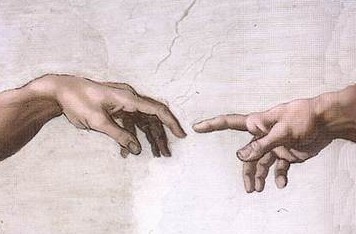
Detail of

Detail of “The Creation of Adam” by Michelangelo [Public domain], via Wikimedia Commons

Augustine tells us that God is merciful yet just. Never new, never old. Varied yet one. Never in need yet glad to gain. He is never covetous yet exacts a return for His gifts.

Still not helpful?

How about this: Augustine states it all in one short sentence, “For even those who are most gifted with speech cannot find words to describe you.”

From the very outset of his journey, Augustine unequivocally states that we cannot know Him. Sure, we may know some things about Him, but in the end, we are really quite clueless. You know what? That’s perfectly OK. That’s how it’s supposed to be. When we encounter Him, not only do we encounter Love, Mercy, and Hope, we also encounter Mystery.

We are always looking for answers. Especially in a society that is so focused on progress, science, technology, and the next “big thing,” not having the answers can be a difficult proposition to accept.

But to truly know God, we have to accept that we can never fully know Him in this life. Mystery.

In the search for God, when we encounter His mystery, we also encounter inexplicable beauty. Volumes have been written about this mystery and beauty, this Person for whom every human being seeks, but yet not all the books of the world would be able to contain Him (cf. John 21.25). We must learn to be at peace with this tension of not knowing and yet moving forward, of encountering the mystery while we allow the beauty of the Triune God penetrate our souls.

It’s OK to not know, to be a bit clueless, or a lot clueless. We all are on this journey together, from the most normal person to the brightest theologian.

The first step is embracing the mystery, taking a leap of faith. Let us open our hearts, allow ourselves to be drawn to Him. Let us encounter the beauty and mystery of God, and be at peace.

For reflection:

  1. What are some unanswered questions you have about God?
  2. Where do you encounter beauty and mystery?

Up next week: Confessions Book 1, Sections 5-6

This is part of a continuing series, Companions on the Journey. You can take a look at previous posts in the series or read the introduction.

Please note: this post was written prior to the attacks in Paris, which I spoke about earlier. I decided to delay it from when it was schedule because it didn’t seem appropriate to post the new installment first thing the morning following that horrific tragedy. Please keep the French people in your prayers. May peace, mercy, and justice triumph over all.

Our Lady of Lourdes, pray for us. St. Joan of Arc, pray for us.

On Paris

By Kriti Shankar (Own work) [CC BY-SA 3.0], via Wikimedia Commons

Interior of Notre Dame de Paris cathedral, by Kriti Shankar (Own work) [CC BY-SA 3.0], via Wikimedia Commons

My heart hurts for the people of Paris today. I cannot begin to fathom what they are going through. I think of the two exchange students our school hosted last year; they were both from France. I wonder what they are going through right now. I remember the french man I met on a train in New Zealand, and I consider whether or not he is in Paris, and what he and his family must be thinking right now.

What are we to do in times such as these?

Pray. Hope. Trust in God. Meet violence with peace, ugliness with beauty and falsehoods with truth.

It has become clear since the attacks last night that they were perpetrated by terrorists from ISIS. When we pray for the repose of the souls who died last night, we must keep those responsible in our prayers as well. When we pray for the victims, we need to pray for the perpetrators of these horrible acts. For our own part, we must also educate ourselves, know what is going on in the world, do what we can to spread Truth, and leave the rest to God.

Pope Francis called last night’s events part of a “piecemeal World War III.” Is he right? I don’t know. But what I do know is that we must stand together with our French brothers and sisters, and all those who come under the shadow of terrorism, of evil, and proclaim the Light that banishes all darkness.

Pray for the victims. Pray for those responsible. Pray for each other, and never lose hope.

Our Lady of Lourdes

Our Lady of Lourdes

Nous vous saluons, Reine, Mere de misericorde, notre vie, notre joie, notre esperance, salut. Enfants d’Eve, nous crions vers vous de fond de notre exil. Nous soupirons vers vous, gemissant et pleurant dans cette vallee de larmes. O vous notre advocate, tournez vers nous vos regards misericordieux. Et apres l’exil de cette vie, montrez nous Jesus, le fruit beni de vos entrailles, tendre, aimante, douce vierge Marie. Priez pour nous, sainte Mere de Dieu. Afin que nous devenions dignes des promesses de Jesus Christ. Amen.

Kokeshi, Rope-making, and Creativity

“Write it. Shoot it. Publish it. Crochet it, sauté it, whatever. MAKE.”
― Joss Whedon

I recently ran into a video of a Japanese doll maker, courtesy of ; it was a fascinating look at one man’s craft and the intricate work in which he engages with his hands. Take a look (and listen):Mental Floss

You can learn more about the Kokeshi dolls here at the original article.

This reminded me of a field trip I had with some of my students last year, when I had the privilege of accompanying several classes for an overnight excursion to Sutter’s Fort in Sacramento. While at the Fort, we all role-played particular roles: the students were assigned specific backgrounds and identities, and had the chance to learn various trades that were prevalent at the time of John Sutter. The teachers and parents taught these trades, and for our part, we had various identities too: I was a Catholic (go figure!) immigrant from a large family who barely made it over Donnor Pass. In addition to my role, I was also a rope-maker, and taught the students how to make good (or not so good) quality rope. Somehow, I imagine my 19th century counterpart had just a little bit more skill than I did after my 30 minutes of instruction.

In any case, while we were there, I was talking with a dear friend, a fellow teacher, about the various trades in which we were employed at the Fort, and she made an astute observation: we were not made for sitting behind a desk; as human beings we need to be doing something. As teachers, we were blessed in the fact that we had active days, interacting with many people, even though there were certainly times that we had to sit at a desk and grade papers, but we both agreed that it would be very difficult to have a typical desk job.

The point, however, was this: no matter what our occupation, we must still be allowed to create in order to be truly fulfilled. Human beings are naturally creative creatures, whether we are participating in the creative aspect of procreation in union with our spouse and in concert with God, or if we are “creating” in terms of physical trade or crafts, or even more abstract ventures such as writing or art. to flourish, we must be allowed, and seek, to participate in the creative nature given to us by God.

Human beings are made in the image and likeness of God, and what is He? He is the creator, the one who brought our entire cosmos into being. If, then, we are made in His image and likeness, then we are naturally creative beings. Does this mean we create like God ex nihilo, out of nothing? No, of course not. But in some way, we still share in that creative nature: at fundamental levels such as procreation, or in more abstract forms such as art, music, writing, hobbies, and even in mundane everyday work. We are driven to creativity, in whatever form the Lord has blessed us. All throughout my life, I have seen evidence of this drive towards creativity: my dad was a florist, my grandfather was a frame-maker and craftsman. I myself enjoy writing, even if I am a bit verbose. Creativity is present in occupations and skills that one would not normally expect to be considered “creative”: my sister, a physical therapist, must examine patients and using her knowledge, form treatment plans that best allow her patients to thrive. A friend who is a massage therapist does the same, as does a close friend who is a nurse in the Navy. Teachers create all the time with their students. Priests must grapple with the mysteries of God, discerning how to present them to their people, begetting spiritual children, and  helping their communities grow closer to Him.

File:Milky Way from France.jpg

I think He did a pretty good job… By BlaiseThirard (Own work) Creative Commons BY-SA 3.0

Some people find this share in the creative outside of their jobs. Hobbies are an excellent example, even some hobbies that some may consider more far-flung: my own interest in astronomy allows me to participate in the creative aspect of God both through observation and the consideration of particular astronomical questions. My grandfather continues to cultivate bonsai plants, and many of my friends create through music. Even at a more basic level, our primary vocations, whether single, married, ordained, or consecrated, draw us into the life of the Trinity, sharing in God’s love and in His creative force.

In whatever way we are called to be creative, we must take joy in our work, seeing the action of the Father, at the prompting of the Holy Spirit, through the grace of the Son, present in our lives and vocation. How are you called to create?

On the Journey: Restless Hearts

Confessions I.1

You have made us for Yourself, Lord, and our hearts are restless until they rest in You.

About twelve years ago, I was driving around one rainy evening, not following any particular route. The music was playing loud (I don’t remember what), and I was ruminating over recent events in my life. I had just been hired at a new job working with at-risk youth, and was doing well in school, which had not always been the case. But something was missing. I was restless.

West Virginia Winding Country Road - ForestWalker.com. Licensed under Creative Commons Share Alike 3.0

West Virginia Winding Country Road – ForestWalker.com. CC BY-SA 3.0

My grandmother had recently passed away and I had attended her funeral Mass with the rest of my family. I was not Catholic yet, but I recognized something in that moment – even though we were grieving her loss, there was also a sense of expectation and joy. She had lived a faithful life and was loved by her family and her community. A pillar of the town she lived in, she was known for her generosity and, especially to us grandkids, her love and good humor. At her funeral Mass, even though our family grieved, I also vividly remembered words of hope spoken by the priest, hope that she would join the Father, a hope that was available to all of us, a hope that invited our hearts to rest in Him. It was at this time in my life that I had started to wonder, “Is there more? Why am I restless? What am I seeking?”

Here among St. Augustine’s first words in the Confessions, he seeks to find how this hope works, how a person comes to faith in the Lord. Does he pray and discover the Lord, or does the Lord make Himself known to the person, drawing the individual to prayer? In the end, Augustine exclaims, “It is my faith that calls to you Lord, the faith which you gave me.” We will not find rest until we reach out to Him, but He invites us, draws us into that same rest which we seek. In other words, we have to respond, but He always starts the conversation.

The important question today, for all of us, is thus: where do we seek our rest? Where is our hope? To be quite frank, my friends, our hope and rest comes from only one place, one Person: our Lord. For some, those may be hard words to hear. For others, they may make perfect sense. At one point in my life, I thought they were sheer lunacy. The more I have studied, prayed, and searched in my life, however, I have found that this is the only answer: our hearts will only find rest when they rest in the Father, guided by the Spirit, redeemed through the Son.

We can all get distracted, seeking rest in things of this world. Some of these things are even very good too! Some of them, well, are not so good. Do we seek rest in all the wrong places? And if we do, how do we find the way back?

I believe this is the walk we will take with our first companion on the journey, St. Augustine: to discover how to still our restless hearts. No person, no thing, no matter how good, will satisfy this ultimate longing that resides in the depths of the human heart. Only until our hearts rest in His heart will they be at peace. May we all seek Him with open hearts, may we find the One who waits for us, who has been waiting for us all along…

Pax.

Come with me by yourselves to a quiet place and rest. -Mark 6.31

For reflection:

1. Where do you seek rest?

2. Is your heart still restless?

Part of an ongoing series, Companions on the Journey

Up next: Confessions Book I, Sections 2-4

Companions On the Journey: Introduction

In the annals of history, there are many spiritual masters who can guide us in the Christian life, and we need the guidance! After all, being a Christian is not easy! We must remember, however, that there have been countless travelers before us, some who have followed similar paths, and others who have followed vastly different paths, but all with experiences that can benefit our spiritual growth.

We are not on this journey alone.

Keeping this in mind, I have decided to start a new series called called “Companions On the Journey.” Praise God, we have many saints to look to for guidance in the Christian life, so from time to time, I will pick a new saint to read and follow as I seek to grow in Christ in my own life. From these readings, I hope to develop reflections for posting here on the blog. It may work, or it may not, but let’s try it out and see how we do. Expect these particular posts to come out once or twice a week. They may deal solely with the text, make connections with other authors I have recently read, or even external happenings around here and back home. The nice thing about the nature of this sort of project is that I can work on it at my own pace and then post-date the entries for later publishing, which should make things a bit easier.

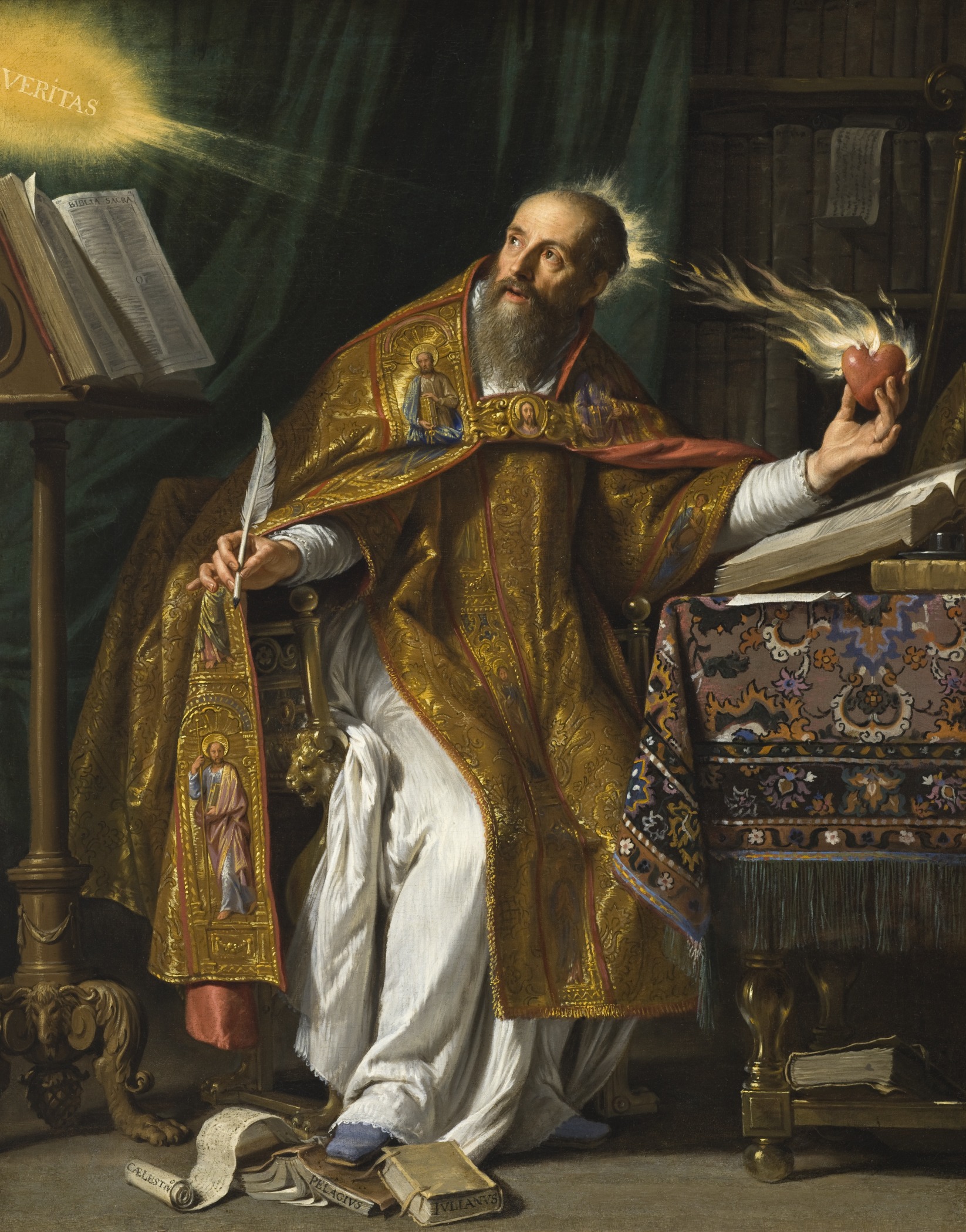
Portrait of St. Augustine by Philippe de Champaigne [Public domain], via Wikimedia Commons

Which brings me to Saint Augustine, our first companion in the journey. As a convert myself, I have always felt a deep connection to his writing, especially his Confessions, so this is where we will start. I will personally be going through the entire Confessions, but I may choose to omit certain reflections from the blog for various and sundry reasons. For these reflections, I will be utilizing R. S. Pine-Coffins’s translation of the Confessions, available in the Penguin Classics series (ISBN 978-0-14-044114-7). If you would like to pick up a copy yourself, I suggest calling Easter’s Books and Gifts (full disclosure: one of their former employees is my Godmother). As far as how long it will take to get through Augustine’s Confessions I am not sure, but I figure we will be journeying with him for a while. Even though I will be reading the entire book, that doesn’t mean that everything in the book will be reflected upon on the blog (we would be here for a very long time). To that end, I will note at the end of each reflection which chapter(s) the next post will focus upon.

If you have any questions or suggestions, feel free to leave a comment, get in touch via Facebook, or fill out the contact form in the “About” section. The first post based on St. Augustine’s Confessions will go live on Saturday morning, beginning with Book I, Chapter 1.

Until then, pax.


This is part of a continuing series, Companions on the Journey, which travels along with a particular companion in the spiritual life, one of the great saints, in order discover how some of their writings might be applicable to our everyday lives. Currently, we are traveling with Augustine of Hippo through his work, Confessions. You can take a look at previous posts in the series or read the introduction.

Silver Glass and a Swift Sunrise

For this is the will of my Father, that everyone who sees the Son and believes in him may have eternal life, and I shall raise him on the last day. – John 6.40

https://www.youtube.com/watch?v=TReKgCLUqqU

Today in the Abbey Church, we celebrated the Mass for All Souls Day, calling to mind all of those who have passed before us. In those moments, there was a tinge of sorrow, yes; perhaps it was a longing to once again be with loved ones. Then again, there was also a joy, a joy that recognizes the loving mercy of the Father who draws His children to His bosom.

It was following Mass, however, during the procession to the monastery graveyard, that the reality of death became more pronounced. As we walked in silence, I was acutely aware of the biting chill that enveloped us. The reds, golds, and browns of the changing leaves gently swayed on their respective branches, ready to fall to the earth. Autumn had certainly descended, preparing the way for the coming of winter, reminding all gathered of the fleeting nature of our lives. Here at the changing of the seasons, the Church in her wisdom has us call to mind the reality of death, the need to pray for each other, and the Paschal Mystery that frees us from that same death.

Entering the graveyard, I was struck like never before by the row upon row of gravestones, monks who had dedicated their lives in faithful service to the Lord. These monks, who crossed an ocean and a vast country to settle in the Northwest had directly affected thousands of lives, and through their work in forming priests, indirectly impacted hundreds of thousands. Filled with gratitude for their witness, I recognized how “they saw the Son and believed in Him.” As we sang the antiphon “In Paradisum”, I was struck at how much God can work in our lives, if we let Him. If we allow His grace to prevail, we will have eternal life. If we follow His example of humility and obedience, death will have no power. Death has yielded to the King who humbled Himself:

Death has become like a tyrant who has been completely conquered by the legitimate monarch; bound hand and foot the passers-by sneer at him, hitting him and abusing him, no longer afraid of his cruelty and rage, because of the king who has conquered him. So has death been conquered. -St. Athanasius

And so as we proceed into the month of November, remembering those who came before, let us give thanks for their influence on our lives and the work that God performed through them. At the same time, let us remember to pray for all those who have departed us, that perpetual light may shine upon them. In a particular way, I am remembering the following individuals (listed by last name), and others whom I am probably forgetting, throughout this month:

Fr. Paschal Cheline

William Childers

Msgr. Andrew Coffey

John Elrod

Fr. Thien Dang

Fr. Richard Doheny

Fr. John Folmer

Fr. Steven Foppiano

Fr. Terry Fulton

Dean Gabbert

Marie Gabbert

Haley Hall

Kevin Keeley

Tim Mar

Don Marshall

Lois Marshall

Don Oehler

Levia Reynolds

Juanita Walker

(If you would like to add anyone, or remind me of someone I should have listed, please let me know either here or via Facebook.)

While the turn of the season and liturgical calendar brings to mind our own mortality, something we should keep in the forefront of our thoughts more often, we need not despair, knowing that through Him, death has lost its sting. Soon, we will enter the period of waiting, looking to His arrival as a small child in a manger, who will go to Calvary in the ultimate expression of love.

I leave you with words that have aways brought to mind, at least for me, thoughts of eternity and a blessed hope:

“Grey Havens” by Alan Lee

And the ship went out into the High Sea and passed into the West, until at last on a night of rain Frodo smelled a sweet fragrance on the air and heard the sound of singing that came over the water. And then it seemed to him that as in his dream in the house of Bombadil, the grey rain-curtain turned all to silver glass and was rolled back, and he beheld white shores and beyond them a far green country under a swift sunrise. -J.R.R. Tolkien

Pax et bonum.

Reflections: On True Discipleship

Twenty-Fourth Sunday in Ordinary Time – Year B

Isaiah 50.5-9A, Psalm 116.1-2, 2-3, 5-6, 8-9

 James 2.14-18,  Mark 8.27-35

What does it mean to be a disciple of Christ? Does it mean helping the less fortunate? Perhaps. As Christians we are called to help the poor and the lonely. Does it mean that we need to act nicely to people, be helpful and courteous to those around us? Maybe, since we are called to be meek and humble of heart. Does it mean that we need to go to Church on Sunday? Yes, I suppose. We need to give reverence where it is due.

To be brutally honest, however, we could be doing all of these things and not have the faintest idea of what it means to be His disciple.

jesuspeter

Being a disciple of Jesus Christ means a complete surrender and sacrifice of our lives. We are called to allow God to open our ears so that we may hear, so that the promptings of the Holy Spirit may guide us throughout our daily lives. This is no easy task! After all, the Holy Spirit doesn’t exactly call us up on the phone or shoot us a text message! Nonetheless, He is there, and if we trust in Him, if we are truly disciples of the Lord, we will allow Him to take and lead us, to be our help and shield, no matter what or who may confront us in life. If we walk before the Lord, as the Psalm says, then our lives will become so much more than doing good works or even going to Church on Sunday (although that is a good, necessary, and essential part of being a Christian): by recognizing our place as children of the Father, He becomes our only light, and again as the Psalm says, He frees us from death and keeps our feet from stumbling. When we open our ears to hear, He in turn hears and guides us with His grace.

We see then that the first step is hearing and listening to God, and that is a big step! I know – I still struggle every day to hear the voice of the Lord, trying to overcome my own shortcomings and foibles. But next, we have to do something, for after all, St. James tells us that if our faith does not do anything, then it is dead. Does that mean that we must prove our mettle as good Catholics through the works that we do? Should I go around saying, “ooh, guess how many Hail Marys I said today” or should I devote all of my waking moments to some sort of project or program, no matter how good, to the exclusion of my prayer life, in order to somehow gain favor with God? Of course not! But the evidence for a true faith is found in its fruit, in the works that it produces, and likewise, works that are not supported by faith carry so much less weight.

So we open our ears to the Lord in order that we may hear, we allow our faith to bear fruit in its works, and then we take another step in our journey, and it is the most important step of all: we follow Christ Himself to the Cross, accepting and embracing the reality of the Paschal Mystery. We cannot be like Peter, rebuking Christ, because if you notice in the Gospel, it is when Peter protests the Cross that he is told by Jesus to “Get behind me, Satan!” Rather, we must “call upon the name of the Lord” and follow Him. We must deny ourselves and take up our own crosses, just as He took up His cross for us. This is not some sort of masochistic thought that we have, wanting to delight in the pain of the cross. No! We take up our crosses to share in His, to come to the reality of the Paschal Mystery and the love of the Trinity. By emptying ourselves, we leave room for Him, and can join Him at the heavenly banquet of which we are called to partake. This is true joy!

By offering ourselves, our joys, our sufferings, our triumphs, and our challenges, we make the sacrifice complete, not in a way that says His sacrifice was somehow incomplete, but rather in that way that St. Paul shows us we complete the sacrifice of Christ, namely by cooperating with His fully effective sacrifice by joining ourselves to Him, or as St. Thomas says, by patiently bearing the trials that God sends us, so as to become like Christ. (cf. Col. 1:24). Only then, through surrender to Him, can we realize the beauty and depth of the Paschal Mystery and come to join Him at His table.

It is from here, my friends, that those good works mentioned above develop into true fruit. Only after we become true disciples, that is by joining Him, taking up our cross and following Him, can we perform the good works to the fullest extent that we are called to perform them: to feed the hungry, relieve the thirsty, clothe the naked, shelter the homeless, visit the sick, visit the imprisoned, and bury the dead. Only by becoming true disciples and opening our ears to hear can we instruct the ignorant, counsel the doubtful, admonish sinners, bear wrongs, forgive offenses, comfort the afflicted, and pray for all people both living and dead. This is a life-long task that has been given to us, and we must strive daily to fulfill it, persevering, and trusting that even when we fail, like Peter did, He is with us.

In Jesus Christ, in his death and resurrection, do we find the true meaning of discipleship, good works, and life itself. To God be the glory.

Reflections: On the Supreme Court, Faith, and Living the Gospel

Thirteenth Sunday in Ordinary Time

Wisdom 1:13-15; 2:23-24; Psalm 30:2, 4, 5-6, 11, 12, 13;

2 Corinthians 8:7, 9, 13-15; Mark 5:21-43

Over the past year, I have cultivated a new practice. Each week, I try to spend dedicated time reflecting on the following Sunday’s readings. It’s a slow process, but I spend time with each passage during Lectio Divina, and then jot down some reflections. This practice has been a fruitful one, and I encourage others to do it too. I suspect that since I am heading back to seminary this fall, it will hold even more meaning for me, and my ministry as a future priest.

This week, however, I had a very difficult time. I’m not sure why, but nothing was coming to mind. All of that changed with the Supreme Court ruling in Obergefell v. Hodges, a ruling that will allow all 50 states to grant marriage licenses to same-sex couples. I suspect that the following words may anger some, and perhaps even affect long-held friendships. I sincerely hope that is not the case, but as a Christian, I also must live and speak to what I know to be true. In any case, back to the ruling…

When news of the ruling broke, some people were jubilant, and others were upset, to say it lightly. There were people literally dancing for joy in the streets, and other people who were sad at the current state of affairs in our country. While my own views on the whole situation should be quite obvious, I would like to speak not about the new reality that faces us in our country (at least not with this post), but rather I would like to speak about the reactions of those associated with the ruling, especially those of my brothers and sisters in the Faith.

As I scrolled through Facebook yesterday, I must say that I was distressed. Some posts talked about how this would usher in the Second Coming (not a bad thing, but still alarmist), others insinuated that all of this would lead to another civil war. Still others said things against the opposing side that caused me to hang my head in embarrassment.

All of this is also true of the other side I might add, in regards to posting things that had no right being there – some of the things I saw posted from those who support the ruling were vicious, vindictive, and outright nasty. In other words, it seemed that some people on both sides should have taken a bit of time to think before pressing the “enter” button, but I’m not here to talk about that right now…

In any case, what I saw from my brothers and sisters in the Faith seemed to disregard what we learn in this Sunday’s Gospel. Here I saw posts written in dejection and despair, whereas in the Gospel reading, we find two individuals who respond to seemingly insurmountable circumstances in the way that we all should respond: with complete and unrelenting faith. In one moment, we see the sick woman, approaching Christ and daring to touch His cloak, hopeful for a healing from her hemorrhages. What happens? She is healed! Upon learning the truth, Christ even responds to her, “Daughter, your faith has saved you. Go in peace and be cured of your affliction.” Faith prevails.

Then in another moment, we see a synagogue official approaching the Messiah, despite admonishments from detractors, seeking His grace and healing touch. Christ reassures the official, telling him, “Do not be afraid; just have faith.” Our Lord proceeds to the official’s house, rebuking other detractors, and approaches the girl, grabbing her hand and raising her to new life. Faith prevails.

Here we have these profound examples of faith and hope in Christ, and yet there are some who were in despair over Friday’s ruling. It just doesn’t make sense.

It doesn’t make sense because we are called to something bigger and better. We are called to be a light in the wilderness, and to live a life of faith, not despairing at the state of affairs in the world. After all, we are called to be in the world, not of the world (cf. Romans 2:12). We are called to live a life of love and witness to the Gospel truth.

But today, what does this life look like? Well, I think we are partially in new territory, so we need to figure that out. But I think that it looks something like this (and in some ways I am speaking to both sides here): we approach all people in love, recognizing them for the children of God that they are, created in His image and likeness. We enter the conversation in a civil manner, seeking not to malign or bring down, but rather to have an open and honest discussion. What’s more, we must stand for Gospel truth. As a Church, we cannot water down the teachings of Christ, but we must also be respectful. We cannot give in to undue compromise, but we also cannot ignore the lived reality of all of those around us. In short, we are called to true and genuine love, the love of Christ, the love that heals all and reconciles all in Him. But this love does not mean ignoring truth; no, truth and love go together in tandem, and must be taken together.

We must be courageous in the proclamation of the Gospel, in both word AND deed. We must defend traditional marriage, voice our opinions, spread Truth, and work to bring authentic Christian values back into our society, but that also means we reach out to those who have different views, in hopes of a fruitful and loving dialogue.  We must also pray for our country, our fellow man, and have faith that Christ, in His love, knows what He is about. After all, He is God.

In short, we are called to love, and Love always wins.

Pax.