Backyard Astronomy: Go outside and look up!

This is part of a continuing series on backyard astronomy. While there is no set frequency on the posts, you can find them (and the initial introduction) here.

I remember like it was yesterday when I saw the Milky Way for the first time. My dad and I were camping, and as we sometimes did, we camped with only the stars as our tent and the granite Sierras as our floor. Looking up, far from city lights, I observed a multitude of stars strewn across the night sky, taking my breath away. Then, over in one section of the dark expanse of the universe I saw it:a band of faint but certainly discernible light touched by darker splotches, both extending across the night sky, almost as if someone had taken a cosmic milk bottle and spilled it on the canvas of the cosmos.

800px-ESO-VLT-Laser-phot-33a-07

Image of the night sky above Paranal on 21 July 2007, taken by ESO astronomer Yuri Beletsky. A wide band of stars and dust clouds, spanning more than 100 degrees on the sky, is seen. This is the Milky Way, the Galaxy we belong to. At the centre of the image, two bright objects are visible. The brightest is the planet Jupiter, while the other is the star Antares. By ESO/Y. Beletsky [CC BY 3.0 (http://creativecommons.org/licenses/by/3.0)%5D, via Wikimedia Commons

Astronomy does not start with expensive telescopes or fancy software. As I used to tell my English students, the best way to get started in one’s journey with the stars is to get away from the lights and look up. Only by using your own two eyes, unaided by any equipment, can you get a true idea of the sheer immensity of the universe. Well, you may not even get a true idea, but you might get an inkling!

So what happens if someone comes to me and says they are interested in studying astronomy? Here is what I would tell them:

  • First, shelf the plans for buying a telescope. You won’t need it for at least a year, although a good pair of binoculars will come into the picture before then.
  • Second, buy a planisphere. These hand-held charts are portable and should be part of the toolkit for any budding astronomer. Find a size that suits you, and make sure it corresponds to your viewing area! Case in point: when I travel to Mexico for language immersion this summer, I need a different planisphere than if I were back at the seminary in Oregon. The planisphere will help you to identify many common objects in the night sky and help you to grow more comfortable in navigating the cosmos.
  • Third, find a small flashlight and cover it with red transparent film. This will help your eyes stay adjusted, as it can take up to 30 minutes for our eyes to grow accustomed to the dark skies. One stray beam of unfiltered light can hamper, or even restart, that process. Use it to view the planisphere, or write in your journal (more on that in a later post).
  • Fourth: Find a comfortable viewing area that gives you a wide-open view if the sky, unhampered by trees AND city lights. Bring some snack and water too, and if it’s winter, don’t forget to dress warmly! If you want to stay off the ground, bring a reclining lawn chair or something similar; the idea is to stay comfortably while you look up for extended periods of time. The light issue is something that is increasingly difficult to overcome as urban sprawl and development continues unabated. Many of my students had never even been stargazing, much less seen the Milky Way!
  • Contact a local astronomy club! Even if you don’t plan on joining the club’s viewing parties, their websites often include tips for local viewing, even providing directions to particularly lucrative observation locations.
  • Finally, share it with someone! Whether it is the local astronomy club as mentioned above, a close friend, significant other, or even an online community, amateur astronomy can bring a lifetime of enjoyment, and what better way to experience the fullness of that enjoyment than by sharing it with like-minded individuals? When we share our experiences, we not only can help teach others, but we can gain new insights ourselves.

Notice how I made no mention of apps or other software. For now, stay away from them, at least while you are actually outside observing! For your first few trips, grow familiar with the night sky by just using the planisphere, rather than relying on technology. When you move on to binoculars or telescopes, it will make your viewing much easier and more enjoyable. I am not saying to never use star-finder apps, just don’t use them yet And by all means, use the internet for research before heading out. If you do end up using a phone app, however, make sure it has a a “red filter” mode or something similar, so as not to disrupt your night vision, and turn off any automatic lock screens and timers that will cause your phone to exit the app, again, for the same reason. See how much simpler it would be without the technology, at least when you are getting started?

There you have it: 6 steps to taking your first foray into night-sky viewing and amateur astronomy; next I will talk a bit about equipment. If you have any questions, comments, or anything to add, let me know. Until then, keep looking up!

Pax.

On the Journey: Spring Cleaning and Attachment to Sin

Augustine’s Confessions Book II, Chapters 4-5

“But our ambition to obtain all these things must not lead us astray from You, O Lord, nor must we depart from what Your law allows.” Confessions II.5

Pears

By Keith Weller – USDA, Image Number K5299-1., Public Domain

Moving has a way of forcing a person to evaluate his or her priorities. As I packed my belongings at the seminary in preparation for my language immersion trip to Mexico and my Pastoral Internship during the next academic year, I realized that I had a lot of stuff to weed out. Some of it were things that I no longer used, or old clothes, or items that I didn’t really need in the first place. Packing gave me a chance to focus on what should be my priority, namely, my formation and preparation for the priesthood, and so I was able to divest myself of quite a few belongings. Many items I kept too, such as those relating to what I consider “central” hobbies or interests in my life: theology, astronomy, or writing (and, of course, Star Trek and Star Wars). All in all, it was a very freeing experience, being able to take stock of everything and discern whether or not it was truly necessary in my life.

All of that said, I must say this: attachment to material things is no small obstacle to overcome!

In this week’s selection, Saint Augustine shows us the danger of attachment to material things. He relates what I consider to be one of the most jarring stories in Book II of the Confessions: when he and several friends stole an enormous amount of pears from a local orchard. This tale may not seem like much, but when one takes into account Augustine’s motivations, the reader can see just how dangerous material covetousness can be. He uses this moment to show how we can be attached to the material world for its own sake, and even more diabolically, how we can even be attached to sin for the mere feeling that it provides. Augustine even admits that he “had no wish to enjoy the things I [he] coveted by stealing, but only to enjoy the theft itself and the sin” (II.4).

We must remember, however, that material objects in and of themselves are not sinful. One does not sin by owning the best computer or the fanciest boat. Sin enters the picture when these items are loved for their own sake, rather than for the end of true joy in glorifying God and building up oneself and others in a positive way. After all, as Augustine notes, “The life we live on Earth has its own attractions as well, because it has a certain beauty of its own in harmony with the world’s beauty” (II.5). The beauty of God and creation as seen through material things cannot be denied! But what happens when we move into excess? Is the fanciest boat or best computer really that necessary?

The danger comes when we attach too much importance to material items, and again, Augustine leads the way in this thinking: “They are of the lower order of good, and if we are too much tempted by them we abandon those higher and better things, Your truth, Your law, and You Yourself, O Lord our God” (II.5). In other words, when we attach an importance to an item, a feeling, or even a person, that is outside of this proper order of things, then we lose our focus and we fall back in on ourselves, leading eventually to sin; we follow Augustine’s footsteps directly into the pear orchard.

camel_needle_gifThe pear orchard, however, is not an endless trap! We must work to reexamine our lives, and place everything where it belongs. We do not sin by possessing material items, but I do believe that it adds a greater burden on our lives, for after all, Jesus Christ tells us that “it is easier for a camel to go through the eye of a needle than for a rich man to enter the kingdom of God” (Matt. 19.24). So let’s take a moment to examine our lives, our attachments, and discern where we can use a bit of spring cleaning.
Just don’t take away my books. Anything but the books!

Questions for reflection:

  1. Do I place inordinate attachment to anything in my life, outside of its proper order, whether that be a person, an object, or even an idea or emotion?
  2. How can I better re-order the priorities in my life so that my material possessions can help me become a better person, in terms of how I treat myself, how I interact with others, and how I relate to and worship God?

Up next time: Confessions II.6-10

This is part of a continuing series, Companions on the Journey, which travels along with a particular companion in the spiritual life, one of the great saints, in order discover how some of their writings might be applicable to our everyday lives. Currently, we are traveling with Augustine of Hippo through his work, Confessions. You can take a look at previous posts in the series or read the introduction.

On the Journey: Cast Off Your Old Self

Augustine’s Confessions Book II, Chapters 2-3

I strayed still farther from you and you did not restrain me…For your almighty power is not far from us, even when we are far from you.Confessions II.2

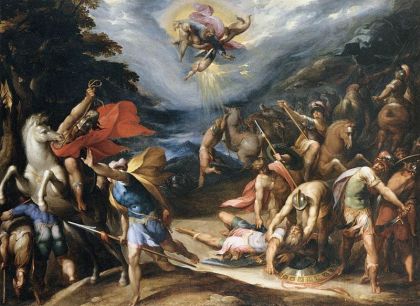
To be Christian is to be in conversion, but that also means that we must recognize our past and God’s presence even in our darkest moments. Here in these two chapters, we find a stark picture of Augustine prior to his conversion to Christianity, seen now through the eyes of Augustine the believer. He recognizes the depths of his depravity and his continued descent into sin and lust, and at the same time recognizes that even though it seemed that God was not present, He was, in fact, always there: “How presumptuous it was for me to say that you were silent, my God, when I drifted farther and farther away from you!” (II.3). Even in the depths of sin, lust, and fornication, Augustine recognizes that God was still present, all at once never impinging on Augustine’s free will, but always waiting for the future bishop to return to His loving embrace.

800px-Hans_Speckaert_-_Conversion_of_St_Paul_on_the_Road_to_Damascus_-_WGA21655

Hans Speckaert (circa 1540–circa 1577) [Public domain], via Wikimedia Commons

Before I was baptized, I lived a life typical of many young people bound up in the world. I was also in school part time, but didn’t really apply myself. My existence consisted of living day-to-day, not really caring about those outside of my immediate reality, and sometimes even less.

Despite my continued spiritual quest through the New Age movement, God was essentially not part of my life, but he was certainly still present. I searched for fulfillment in all the wrong places, and like Augustine, “I should have awaited your [God’s] embrace with all the greater joy” (II.2). I found that while He was not a part of my life, I was certainly a part of His; in other words, He was always present, a fact that I can see so clearly now that I can hardly believe that I didn’t see it before.

I never saw him working through my parents. Through my mom’s and dad’s encouragement, or my sister’s willingness to be with her little brother (even when he was annoying). I didn’t see Him in the presence of my grandparents, who did so much to support my sister and myself, particularly my grandmothers, who constantly showered love on both of us and prayed for us every day. I never saw his presence in that of my teachers, who tried to push me beyond my own self-imposed procrastination-laden limits. In short, I was blind to His love present in the actions of others, and I wouldn’t begin to discover it until I was nearly 20 years old.

When we are mired in selfishness and sin, we are blind to God, our neighbors, and ourselves. Sin and vice cut us off from the divine life, and leave us empty, thrown askew into the world, to the point to where sin itself becomes the goal, in order to meet the expectations of the world, rather than seeking the goal that is heaven:

Nothing deserves to be despised more than vice; yet I gave in more and more to vice simply in order not to be despised. If I had not sinned enough to rival other sinners, I used to pretend that I had done things I had not done at all, because I was afraid that innocence would be taken for cowardice and chastity for weakness. (II.3)

But of course, we have hope, so much hope! Following Jesus Christ, we find that God is in fact always present in our lives, no matter what the mistake, misstep, or sin. We may find it difficult to approach His love, especially amidst a world that has, in many cases, confused sin for virtue, vice for love.

Like Augustine, let us begin to move toward God and heed the words of Saint Paul:

Put off your old nature which belongs to your former manner of life and is corrupt through deceitful lusts, and be renewed in the spirit of your minds, and put on the new nature, created after the likeness of God in true righteousness and holiness. (Eph. 4.22-24)

Questions for reflection:

  1. Where has sin and vice made me blind to God’s presence in my life?
  2. How has God worked through other people in my life in order to draw me closer to Him?

Up next time: Confessions II.4-5

This is part of a continuing series, Companions on the Journey, which travels along with a particular companion in the spiritual life, one of the great saints, in order discover how some of their writings might be applicable to our everyday lives. Currently, we are traveling with Augustine of Hippo through his work, Confessions. You can take a look at previous posts in the series or read the introduction.

+JMJ+

Finals are finally done!

Hey there folks – Dean here… It’s been a while, but I have a good reason (as I am sure my mom would agree with me): We’ve been preparing for finals and other end of the year happenings, which has left me with little personal writing time.

As of five minutes ago, however, I submitted my last paper for the semester.

So what comes now? Well, over the next week, there will be some new material, both in terms of science and and faith, particularly the ongoing “Journey” series, currently focusing on Saint Augustine. I will also introduce a new series of posts, “The Believing Astronomer Lost in Mexico,” chronicling my upcoming experience with language immersion in Mexico City.

As always, to God be the glory in all things, and know that you remain in my prayers. Please pray for me, and my brother seminarians, as well! As we near Pentecost, let us pray for the descent of the Holy Spirit in all our lives, that we may be ready to invite Him into our Hearts and give glory to the Father through His most glorious Son!

Pax.

On the Journey: The Importance of Reflection

Augustine’s Confessions Book II, Chapter 1

For love of your love I shall retrieve myself from the havoc of disruption which tore me to pieces when I turned away from you, whom alone I should have sought, and lost myself instead on many a different quest.Confessions II.1

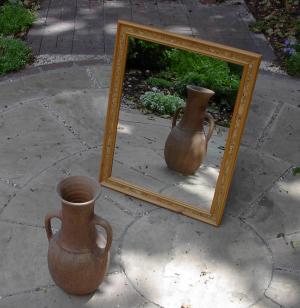
Mirror

By Cgs (GFDL or CC-BY-SA-3.0), via Wikimedia Commons

Self-reflection is, I think, largely a lost art in today’s world. So often we hear about people going about their daily lives, merely allowing the unrelenting pull of existence to carry them where it will, living without intentionality. We often fail to look at where we have been, and so miss where we might go, where the Lord is leading us, where the Spirit speaks to the still quiet recesses of our hearts. Our lives are filled with noise, and so we fail to hear not only the Lord, but our own inner voices as well, and simply allow ourselves to be swept away.

When I fist entered seminary, I received a it of advice from my mom: from the beginning, keep a journal. She recognized the importance of self-reflection, and encouraged me to develop this skill which, I eventually found, became indispensable in my daily life. The journal has ebbed and waned over the years: sometimes there are consecutive daily entries, and sometimes I may go several weeks without writing anything down. I have tried, however, to keep my mom’s advice, advice that has helped to shape not only my experience in seminary, but to shape so many other aspects of my life as well. Self-reflection, if we hope to grow closer to God and embrace our humanity to its fullest potential, is indispensable.

In his first chapter of book II, Augustine endeavors to show just how indispensable reflection can be. He realized that in order to move forward in his spiritual journey, he needed to look back as well: “I must now carry my thoughts back to the abominable things I did in those days, the sins of the flesh which defiled my soul. I do this, my God, not because I love those sins, but so that I may love you. For love of your love I shall retrace my wicked ways” (Confessions II.1) Here we see two main points regarding self-reflection which must not be forgotten:

  1. While we do indeed turn inward, at its core, reflection isn’t merely something to look back and see how good or bad we are, but it should in fact help us to turn outward toward God, giving Him thanks and asking for His grace and mercy.
  2. Sometimes self-reflection is not a pleasant process; in order to grow, we must accept both the good in our lives as well as those areas in which we have fallen in order to gain a true self-understanding of where we stand before God.

In the end, Saint Augustine did not take on this task because he loved his sinful past, or even to put on a show to display how great a sinner he was, and so how holy he had become after his conversion, but rather he took on the task of self-reflection to grow closer to God. He knew that in order to more fully unite himself to the Holy Trinity, he needed to reflect on the “different quests” of his life, seeing in those moments where God had been the entire time. So, too, can we look at those different quests in our lives, discovering the presence of the Lord in both the smallest moments and biggest breakthroughs, in times of failure, and in times of triumph.

This is the key: in everything we do, we must set as our goal to grow closer to Him, whether it is self-reflection, or daily work, or taking on some new adventure. In this way, we begin to truly “seek the things that are above” (Col. 3.1).

Questions for reflection:

  1. Do I undertake a daily examen, or even journaling,  in order that I may more fully reflect on my life?
  2. How can I live to be more intentional, rather than letting the tides of the daily grind sweep me away?

Up next time: Confessions II.2-3

This is part of a continuing series, Companions on the Journey, which travels along with a particular companion in the spiritual life, one of the great saints, in order discover how some of their writings might be applicable to our everyday lives. Currently, we are traveling with Augustine of Hippo through his work, Confessions. You can take a look at previous posts in the series or read the introduction.

+JMJ+

Bill Nye and the Loss of the Liberal Arts

Bill NyeThis past week, Bishop Robert Barron published a critique on a recent video posted by Bill Nye, known to us millennials as The Science Guy. In the video, Nye answers a question from a philosophy student (full disclosure: I have a degree in philosophy) who asks whether or not philosophy is still relevant. Nye answers in the negative, and while he provides one or two salient points (such as the fact a career in philosophy is not exactly lucrative, but most people going into it know that anyway), for the most part, he misses the point entirely; it’s quite clear that he is outside his field of expertise. While I think that Bishop Barron does take some of Nye’s examples too seriously, I whole-heartedly agree with the Bishop’s main point: Nye fails to realize that in order to truly flourish as a society, we need philosophy, and the other liberal arts, to teach us about beauty, truth, and the intrinsic value of the human person. As Bishop Barron points out:

Father BarronThe physical sciences can reveal the chemical composition of ink and paper, but they cannot, even in principle, tell us anything about the meaning of Moby Dick or The Wasteland. Biology might inform us regarding the process by which nerves stimulate muscles in order to produce human action, but it could never tell us anything about whether a human act is morally right or wrong. Optics might disclose how light and color are processed by the eye, but it cannot possibly tell us what makes the Sistine Chapel Ceiling beautiful. Speculative astrophysics might tell us truths about the unfolding of the universe from the singularity of the Big Bang, but it cannot say a word about why there is something rather than nothing or how contingent being relates to non-contingent being. How desperately sad if questions regarding truth, morality, beauty, and existence qua existence are dismissed as irrational or pre-scientific.
Science is, indeed, a critical and necessary part of our lives. Without science, we would still be in an age that equated astronomy with astrology and chemistry with alchemy. We cannot, however, throw out philosophy and the other liberal arts. As Bishop Barron points out later in the article, without these disciplines, we wouldn’t “know anything about how to live a decent life, how to differentiate between the sublime and the mundane, how to recognize God.” I have great respect for Bill Nye. He taught me a lot about investigative science when I was a kid, and now as CEOt of the Planetary Society, he has done a lot of good work to increase awareness of the need for planetary exploration. That said, he certainly does not understand philosophy or the value of the liberal arts.

While our lives would be dark and perhaps even more dangerous without science, so too would they be dreary, boring, and meaningless without philosophy, without literature, without a study of the human person in all its glory and brokenness, without a recognition of the good, true, and beautiful.

Science, specifically astronomy, pointed me in the direction of faith, but it could only go so far. In the end, it was these other disciplines, and most of all Divine Grace, that carried me the rest of the way. I suppose Bill Nye would see that as trite and perhaps a bit deluded. That’s OK.

Come to think of it, Grace carried me the entire way from the beginning, because it was probably by His grace that the first book I ever checked out from the library was a book on the solar system, initially piquing my interest in the larger universe. Then, years later, He would draw me closer to Him through the recognition of that same beauty I could see through the telescope was created by Goodness itself, with His Son by my side the whole time, waiting for me to open my heart to the promptings of the Spirit so that I might come to faith and trust in Him.

Pax.

You can see the original video here. 

Find more from Bishop Barron and his Word on Fire Ministries here.

Second Sunday of Easter: Divine Mercy Sunday (Reflection)

For His mercy endures forever…

Acts 5:10-16, Ps. 118.2-4, 13-15, 22-24

Rev. 1.9-11A, 12-13, 17-19

800px-The_Incredulity_of_Saint_Thomas_by_Caravaggio

The Incredulity of Saint Thomas by Caravaggio [Public domain], via Wikimedia Commons

What is mercy? Well, let me ask you another question, in hopes that we discover the answer: Are you a “doubting Thomas?” If you are anything like me, there have probably been many times throughout your life where you could answer “yes” to that question. Especially in our world today, we tend to look for hard, physical evidence, looking for the scientific basis of this or that situation. But even more so, I think there is another reason why we can call ourselves, at times, “doubting Thomas.” It’s hard for us to believe that our Lord, Jesus Christ, Son of God, hung upon the cross for us, and not just us as a collective group, but for you and me individually, as if we were the only persons in existence. Even though it is only a week after we celebrated the Resurrection of our Lord, we might have doubts and questions! But this is why we celebrate Divine Mercy Sunday, to serve as a reminder that all of us have received the free and unmerited gift of His mercy, that His triumph over death is real, if only we are willing to accept it. We see this in our first reading as the “believers in the Lord” were gathering: even though they were sick and maligned, “they were all cured”[1] at the hands of the apostles. Nothing was asked of them but faith in Jesus Christ, and nothing more is asked of us in order to find true healing. All we have to do to accept this gift of mercy is proclaim Jesus as the one who triumphed over death, and to embrace that “[our] strength and [our] courage is the Lord.”[2]

So let’s return to the image of the doubting Thomas: where can we find mercy? A doubting Thomas looks for the proof, and finds it difficult to accept in faith, something that many of us may be able to readily identify with! The beautiful reality, brothers and sisters, is that He brings the proof to us; He meets us right where we are at, with all of our sins and failings, inviting us to something more, something beautiful and glorious. This is mercy! When Thomas expresses his doubt, the Lord, in His mercy, approaches him and invites Thomas, invites him!, to bring his hand and place it into the Lord’s side. Only then, when Thomas is able to physically touch the Lord, does He exclaim, “My Lord and my God!”[3] The Lord knew Thomas, and knows us, and just as he knew that Thomas needed that moment of physical touch, so too does He know exactly what we need in order to experience and accepts His grace and mercy. Mercy is the Lord reaching out to us.

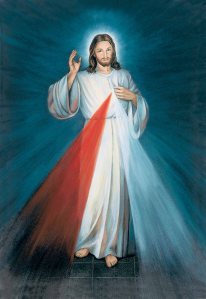
Divine Mercy

Pope Francis describes mercy as, “the bridge that connects God and man, opening our hearts to the hope of being loved forever despite our sinfulness.”[4] But we do not build this bridge; it is Christ’s mercy, Christ’s bridge, that brings us closer to Him. Just as the Lord knew what bridge had to be built for Thomas, namely showing him and allowing him to feel the wounds in His side, He knows as well just what form the bridge needs to take for us, but we have to be willing to cross it to accept His mercy.

But where is our bridge? Of course, each one of us experiences Christ’s everlasting mercy and love in a unique manner, but it all flows from one place: from the sacraments, from confession, and most especially, the Word made flesh on the Eucharistic table. It is here that He calls to us and tells us, “do not be afraid.”[5] In His mercy, He provides the bridge, beckoning us to open our hearts to being led across, telling us, “do not be unbelieving but believe.”[6] The gift is there waiting for us; we just have to accept it. When we do cross this bridge, we die to sin, and are born to new life.[7]

So brothers and sisters, the Lord invites you and me, as He invited Thomas, to a deep and personal encounter with Him. This encounter, which takes place especially in the Eucharist and Confession, is one where we will discover the mercy of Christ, “by whose Spirit [we] have been reborn and by whose blood [we] have been redeemed.”[8] Let us “receive the Holy Spirit”, inviting mercy into our lives. As we profess our faith, let us keep the Easter acclamation, “Alleluia!” in our hearts, minds, and actions, proclaiming to the world that His mercy endures forever, and His love is indeed everlasting.[9]


  1. [1] Acts 5.16
  2. [2] Psalm 118.15
  3. [3] John 20.26
  4. [4] Pope Francis, Misericordae Vultus
  5. [5] Rev. 1.17
  6. [6] John 20.27
  7. [7] CCC 1988
  8. [8] Collect for 2nd Sunday of Easter, Yr. C
  9. [9] Ps. 118 and Response

On the passing of Mother Angelica

“The sun and all the stars cannot compare with the beauty of one holy soul.” -Mother Mary Angelica of the Annunciation, PCPA, founder of EWTN

Mother Angelica

If there is one thing I hope to express with this blog, with as much as I love astronomy, it is the above sentiment given by Mother Angelica; if there is a second, it is the fact that we are all on a journey to becoming that holy soul, a journey that has twists, turns, hills, and valleys. That’s OK. Mother Angelica experienced that in her own life too.

Mother Angelica, the founder of EWTN, passed to her reward this Easter Sunday, March 27, 2016. Today she was laid to rest in Alabama, her home for almost 60 years (you can read the homily here).

If it were not for Mother Angelica, I probably wouldn’t be a Catholic, much less in seminary studying to be a priest.

About the same time I was first considering the Church after stumbling into a Catholic bookstore, I also discovered the Eternal Word Television Network. The first show I saw on this strange Catholic T.V. network (who knew Catholics had bookstores, much less television stations!) was, you guessed it, Mother Angelica’s famous call-in program. By this time she was in reruns, as she had experienced a severe stroke three years prior to my discovery, but her points were no less relevant. In fact, I have found that the more I have watched her over the years, the more I see that she knew what she was talking about, and could foretell where our society was heading.

So I watched as much of this old nun on T.V. late at night as I could, as I didn’t want my roommates discovering my secret (let’s just say they weren’t fond of Catholics). Mother Angelica, in her straightforward, no-nonsense, and humorous manner taught me about the faith. Along with the catechism lessons I was receiving at the time, and with the many books given to me by the aforementioned bookstore, Mother Angelica imparted to me a foundation in the faith I will cherish to my last days. She was truly a Godsend in my life, and the lives of many others, teaching us about faith, hope, love, beauty, and the value, and necessity, of sacrifice. She taught us about trusting in God, radical obedience, and keeping our hearts open to the promptings of the Holy Spirit. In other words, she taught us about being followers of Jesus Christ.

Thank you, Mother Angelica, for so readily responding to the Lord’s call, and for following Him in all things, no matter what the cost. If, in my vocation and life, I can emulate your example even by a fraction, then it will have been fruitful. May you come you come to rest in the peace of Christ, and hear those words which we all long for: “Well done, my good and faithful servant. Enter now into your Master’s house…” Thank you, Mother Angelica, for being that beautiful soul, for outshining the sun and all the stars.

Réquiem ætérnam dona ei Dómine; et lux perpétua lúceat ei. Requiéscat in pace. Amen.

You can find more about Mother Angelica, including writings and video, at EWTN’s memorial site.

Book Review: The despairing hope of Childhood’s End

I tend to dole out five star reviews like candy on halloween night, but five star reviews are few and far-between. Five star reviews are reserved for exceptional works of literature that leave an emotional impact, that cause me to consider deep questions of life, spirituality, or philosophy, or even have me up reading all night long with complete disregard of the massive exam that I have the following morning. We are talking books such as the Lord of the Rings trilogy or Asimov’s Foundation trilogy.

Childhood’s End by Arthur C. Clarke is one such book worthy of the 5 star rating. The feeling I had when I finished it last night could best be described as “despairing hope.”

CE bookcover

(Some spoiler-y material ahead, but nothing too explicit)

Starting off, the plot seems quite obvious. The Overlords, a seemingly benevolent race, appear one day and firmly, yet unobtrusively, take control of Earth. War, sickness, poverty… All gone within a generation. But what are the ultimate motives of the Overlords?

Then finally the Supervisor of Earth, the Overlord known as Karellen, makes an appearance, and his appearance harkens back to fears of an age long-past.

All proceeds as planned, and Earth continues on, but something unexpected happens. Something terrible. Something wonderful. Something that will change humanity forever….

If I had one complaint about the novel, it would be that it lacks a bit in character development. The book is short, and moves quickly, but there are moments when I wished Clarke would have spent a little bit more time fleshing out a couple of characters. Despite this drawback, however, I will say that I was genuinely invested in their plight, and touched by the end result of the book.

Childhood’s End is truly a science fiction masterpiece. The work is episodic in nature, but Clarke pulls it off well. As a religious person, I found many of the ideas he presents thought-provoking. I didn’t agree with all of them, but I definitely appreciated his reasoning behind them. While the book can at times seems dated (computers still fill entire rooms), he makes some surprising predictions, such as the advent of holograms.

Clarke’s novel is a quick read that still contains plenty of depth, good for vacation.

Are you ready for your childhood to end?

Childhood’s End rating: 5/5 stars for its scope, examination of the human condition, quality of prose and storytelling, and for its strong adherence to the traditional science fiction genre.

(The above review appeared originally on my Goodreads profile)

Social Networks, Nanobots, and the Dignity of the Human Person

We just recently took part in a two-day symposium here at the seminary looking at the place of technology and social media in our lives, what it means for our ministries, and the impact that it may have on our future. While I hope to write a longer post in the coming days regarding the symposium, I will say that we covered many topics with our presenters, Sr. Mary Timothy Fokes, FSE, and Fr. William Holtzinger of the Archdiocese of Portland in Oregon, ranging from social networking to nanotechnology to artificial intelligence, and even the integration of technology and the human mind itself. I just stumbled upon this article focusing on a recent interview of Ray Kurzweil by Neil deGrasse Tyson, one of the authors from which Sr. Timothy derived her research. Fascinating and thought provoking…

From the article:

When I talk about computers reaching human levels of intelligence, I’m not talking about logical intelligence…It is being funny, and expressing a loving sentiment… That is the cutting edge of human intelligence.

The question with which we will be faced: how do we maintain the dignity of the human person in this rapidly evolving world and what can we personally do to achieve this goal, no matter what the technology? I am certainly not saying there is no answer to this question, I am simply saying that we need to keep it at the forefront as we develop these technologies!

Be sure to check out the article and accompanying video of the interview with Kurzweil and astrophysicist Neil deGrasse Tyson!

Pax.