On the Journey: Moving with the Torrent

Note: Regular readers may notice some changes. Please hang in there while the dust settles; I will be posting an update on said changes (including background on the new address and blog title) this weekend. You can still expect reflections on faith, literature, and current events, but I also want to include more science (and specifically astronomy) based content as well. As always, I reserve the right to post as frequently or infrequently as needed, due to my primary duties and busy schedule as a seminarian and graduate student in Theology. Pax.

Augustine’s Confessions: Book I, Chapter 16

But we are carried away by custom to our own undoing and it is hard to struggle against the stream. Will this torrent ever dry up? How much longer will it sweep the sons of Adam down to that vast and terrible sea which cannot easily be passed, even by those who climb upon the ark of the Cross?Confessions I.16

Do not be led away by diverse and strange teachings; for it is well that the heart be strengthened by grace, not by foods, which have not benefited their adherents. -Hebrews 13.9

Bhs_int_classroom_la

Not for the faint of heart! Photograph of Battlefield High School, taken 2 Feb. 07 by K.D. Reeves. Public domain, free for public use and consumption. Complies with Prince William County School photo use guidelines. Via Wikimedia Commons

Being a teacher is tough. I know. Even though I was not in education any great amount of time, I worked in both the private and public systems. My experience ranged from being an assistant in a program that welcomed students with the most difficult situations and histories to teaching English in a small Catholic school.

Yes, teaching is tough. As a teacher, you are left with the responsibility of forming young minds, of helping them grow and become well-formed individuals. Your job extends far beyond school hours. The Lord knows how many late nights I spent up as a teacher! It is not for the faint of heart, for teaching is one of the greatest tasks a person can undertake.

And yet, there are teachers out there who lead their students astray. Whether through imposing their own personal ideologies or teaching outright error inside the classroom or outside the classroom, it is sad to note that some teachers do not lead their students down the right path, and this is what Augustine speaks about in this week’s passage. He recognizes that many of his instructors not only taught contraditions, but taught outright error as well. I know that many reading this may think that surely it is not so bad today (even I bristle at all of this), but I wouldn’t be so fast to make that assumption. While I have been blessed to work with some of the most gifted educators who deserve far more credit than they have received (specifically those in the Catholic school and those who worked with students who experienced Emotional Disturbance), I have also recognized that many parts of the system are broken, particularly in public schools. False ideologies trump truth and more money is thrown at the problem, rather than trying to spend the existing money more responsibly.

Educators have a lot of hard work ahead of them, and we need to pray for those dedicated teachers who seek to teach and form their students properly! But, that’s not what this post is about. This post is about the student…
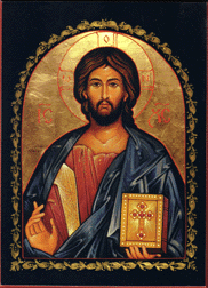
Christ the Teacher icon

Christ the Teacher Icon

Augustine recognizes that even though some of his teachers led him down wrong paths, he was more than willing to follow them: “It is true that I learned all these things gladly and took a sinful pleasure in them. And for this very reason I was called a promising boy” (I.16). Augustine acknowledges that even though teachers have a certain responsibility, so to do the students. As we journey on the spiritual path, we should and must look to others for guidance. But those whom we seek need to be well-founded in the truth.

Let’s look at science: would you trust an established scientist who presents peer-reviewed research, or the guy selling snake oil or other “get well quickly” schemes in order to treat an illness? Would you look to an experienced cosmologist to teach you about the universe or the conspiracy theorist who sees shadows around every corner?

But what about our faith? How does all of this apply to Christianity? As Catholics, we have the authority of the Scripture, Tradition, and the Magisterium. Clinging to the Word of God, looking to the history of the Church, and allowing ourselves to be rightly guided by our shepherds, we can grow closer to the Lord. Some practical ways to do all of this are to read Scripture daily, study the lives of the saints, and get to know the Catechism. In the next few days, I will pass along some helpful hints on reading Scripture and staying with it.

There is one true teacher, but we as students must choose to follow Him.

Questions for reflection:

  • What can I do to better inform myself about my faith?
  • Have I allowed myself to be carried away by strange teachings?

This is part of a continuing series, Companions on the Journey, which travels along with a particular companion in the spiritual life, one of the great saints, in order discover how some of their writings might be applicable to our everyday lives. Currently, we are traveling with Augustine of Hippo through his work, Confessions. You can take a look at previous posts in the series or read the introduction.

Pic of the Week: A Universal Scale

(If you were a subscriber to The Road Goes Ever On, from walkingamdg.wordpress.com, things may look a bit different. Don’t worry, I’m simply redesigning the site a bit, including adding a new custom address: BelievingAstronomer.com, with a focus on faith, science, literature, reflections, with news and reviews thrown in from time to time. A longer post will be added this weekend, as I am currently on retreat and this post is simply a pre-scheduled item that I set up at the end of December. Feel free to tell me what you think!)

From time to time, I will post interesting pictures from astronomy and cosmology, although expect a few surprises too… I’m talking science fiction, faith, or other branches of human knowledge that relate to this enterprise. This week, however, we look at the solar system. In fact, we look at how mind-bogglingly huge our solar system is through NASA’s own APOD, which, incidentally, has brought us a video rather than a picture. Enjoy!

From NASA:  Want to build a scale model Solar System? A blue marble 1.4 centimeters (about half an inch) across would be a good choice for a scale model Earth. Since the Sun is 109 times the diameter of Earth, a 1.5 meter diameter balloon could represent the Sun. But the distance between the Earth and Sun, 150 million kilometers, would translate to just under 180 meters (590 feet) at the same scale. That would mean the completed project, including the orbits of the outer planets, is probably not going to fit in your backyard. Still, you might find enough room on a dry lakebed. Check out this video for an inspirational road trip through the Solar System to scale.

On The Journey: Christmas with Augustine

Rather than continue with Augustine’s Confessions this week, I thought I would reflect rather on one of his Christmas sermons.Then I read the selection in this morning Office of Readings in the Liturgy of the Hours and remembered that today’s reading comes from Augustine himself, incidentally from one of his Christmas sermons. I read it, reflected upon it, and once again found it eye-opening and inspiring. Then I thought to myself, rather than post my own ramblings, why not let Augustine speak for himself this week?

And so I leave you with Saint Augustine and his words on the mystery and reality of Christmas. God bless you all, and I hope you have a joyous Christmas!

Awake, mankind! For your sake God has become man. Awake, you who sleep, rise up from the dead, and Christ will enlighten you. I tell you again: for your sake, God became man.

Nativity,_Follower_of_Vasco_Fernandes

Nativity, Vasco Fernandes [Public domain], via Wikimedia Commons

You would have suffered eternal death, had he not been born in time. Never would you have been freed from sinful flesh, had he not taken on himself the likeness of sinful flesh. You would have suffered everlasting unhappiness, had it not been for this mercy. You would never have returned to life, had he not shared your death. You would have been lost if he had not hastened to your aid. You would have perished, had he not come.

Let us then joyfully celebrate the coming of our salvation and redemption. Let us celebrate the festive day on which he who is the great and eternal day came from the great and endless day of eternity into our own short day of time.

He has become our justice, our sanctification, our redemption, so that, as it is written: Let him who glories glory in the Lord.

Truth, then, has arisen from the earth: Christ who said, I am the Truth, was born of a virgin. And justice looked down from heaven: because believing in this new-born child, man is justified not by himself but by God.

Truth has arisen from the earth: because the Word was made flesh. And justice looked down from heaven: because every good gift and every perfect gift is from above.

Truth has arisen from the earth: flesh from Mary. And justice looked down from heaven: for man can receive nothing unless it has been given him from heaven.

Justified by faith, let us be at peace with God: for justice and peace have embraced one another. Through our Lord Jesus Christ: for Truth has arisen from the earth. Through whom we have access to that grace in which we stand, and our boast is in our hope of God’s glory. He does not say: “of our glory,” but of God’s glory: for justice has not proceeded from us but has looked down from heaven. Therefore he who glories, let him glory, not in himself, but in the Lord.

For this reason, when our Lord was born of the Virgin, the message of the angelic voices was: Glory to God in the highest, and peace to his people on earth.

For how could there be peace on earth unless Truth has arisen from the earth, that is, unless Christ, were born of our flesh? And he is our peace who made the two into one: that we might be men of good will, sweetly linked by the bond of unity.

Let us then rejoice in this grace, so that our glorying may bear witness to our good conscience by which we glory, not in ourselves, but in the Lord. That is why Scripture says: He is my glory, the one who lifts up my head. For what greater grace could God have made to dawn on us than to make his only Son become the son of man, so that a son of man might in his turn become the son of God?

Ask if this were merited; ask for its reason, for its justification, and see whether you will find any other answer but sheer grace

Questions for reflection:

  • Have you been asleep, and if so, how?
  • What do you need to do in order to wake up, to bear witness to the Lord?

This is part of a continuing series, Companions on the Journey, which travels along with a particular companion in the spiritual life, one of the great saints, in order discover how some of their writings might be applicable to our everyday lives. Currently, we are traveling with Augustine of Hippo through his work, Confessions. You can take a look at previous posts in the series or read the introduction.

Fourth Sunday of Advent: Christ is coming; are you ready? (Reflection)

Fourth Sunday of Advent – Year C

Micah 5.1-4a, Ps. 80.2-3, 15-16, 18-19

Heb. 10.5-10, Luke 1.39-45

Christ is coming; are you ready? Oh, we are getting ready for many things in these last days before Christmas: family, celebrations, gifts… But are we ready for what, for who, really matters: the coming of Jesus Christ?

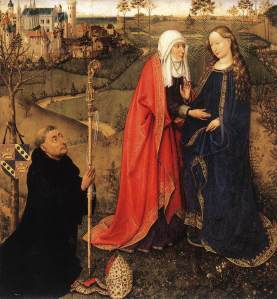
Visitation, from Altarpiece of the Virgin (St Vaast Altarpiece) by Jacques Daret via Wikimedia Commons. Public Domain

Visitation, from Altarpiece of the Virgin (St Vaast Altarpiece) by Jacques Daret via Wikimedia Commons. Public Domain

In the Gospel today, we read the story of the Visitation, one of the events on which we also meditate when we pray the joyful mysteries of the rosary, where the Virgin Mary, who has been visited by the angel Gabriel, travels “to the hill country in haste,” seeking her cousin, Elizabeth.[1] We see this young girl, perhaps riding a donkey, moving quickly along, looking forward to visiting her cousin, as she approaches a small house. Then another woman, older than Mary, comes out. This person, Elizabeth, is understandably excited to see her cousin and opens her arms in welcome. But then we see something else, something more: Elizabeth, who is by this time visibly pregnant, feels the child in her womb, John the Baptist, leap for joy. This is the same John the Baptist whom we heard last week announce, “one mightier than I is coming.”[2] Elizabeth, immediately recognizing what is happening, exclaims those words that are so familiar to us: “Blessed are you among women, and blessed is the fruit of your womb.”[3]

What if Mary, with the Christ-child in her womb, were to come to our door? Would we leap for joy like John the Baptist? Would we react in wonder and gratitude, asking, “How does this happen to me, that the mother of my Lord should come to me?”, like Elizabeth? Or would we notice at all, absorbed with all of the busy details of the Christmas season?

In other words, would we react to the coming of Christ with hospitality or indifference? As we grapple with how we would react, we can take our cue from one of the great saints in Western civilization, Saint Benedict, who told his followers, “all should be received as Christ.”[4] I think this is what we should strive for in this Christmas season: we must strive for true hospitality, whether we are receiving others or receiving Christ Himself, since as believers, we know we are indeed receiving Jesus Christ when we encounter those around us in our daily lives. In the person of Elizabeth, and even in John the Baptist who was still in her womb, we see a striking example of hospitality: there is no trepidation, no fretting over this or that detail, just pure joy and wonder. Granted, they had the privilege of literally welcoming Christ.

Then again, we have that privilege too. We encounter Christ in an intimate and miraculous way on the Cross. That child in Mary’s womb, the one that will “stand firm and shepherd his flock, by the strength of the Lord” and whose rule “shall reach to the ends of the Earth”[5] will one day leave Bethlehem and enter Jerusalem, giving Himself up on the cross, dying for us. That small infant who is to be born in five days, who we are called to welcome with open arms, the child for whom the Innkeeper didn’t even have hospitality for, will offer His body once for all[6], destroying sin, opening up to us the gates of heaven. Even in this early moment with Elizabeth, we get a glimpse of the true nature of the child who will make the journey from womb to manger to cross and finally to the tomb. Let us remember all of this when He approaches us!

And He does approach us! We encounter Him on the cross, and so we encounter Him now in the Eucharist: in humility and mercy, he entered Mary’s womb, in humility and mercy he died on the cross for our sins, and in humility and mercy, he comes to us today, “just as He filled with His power the womb of the Blessed Virgin Mary.”[7] Let us open the doors of our hearts in hospitality, seeking to embrace His presence, welcoming His “humility who bears witness to the truth.”[8] Let us follow the example of Mary, who “most perfectly embodies the obedience of faith” by welcoming “the tidings and promise brought by the angel Gabriel”[9] as we seek to invite Christ into our lives.

In these final days of Advent, the Holy Spirit prompts us to welcome the infant Christ with open arms and hospitality, calling upon His name, so that He will give us new life.[10] As Christmas draws near my friends, “may we press forward all the more eagerly”[11], inviting Him into our hearts, even leaping for joy, knowing that in five days, our God will be born in a manger, He who “shall be peace”[12], in the anticipatory hope that one day we will hear the words, “Blessed are you who believed.”[13]

Christ is coming. Are you ready?


On the Journey: Bad Grades and Prideful Students

Augustine’s Confessions: Book I, Chapters 13-15

(I will provide a link to an online translation next week; my usual source seems to be down at the moment. Although for my personal use and for these reflections, I am using this translation.)

“O God, You are the Light of my heart, the Bread of my inmost soul, and the Power that weds my mind and the thoughts of my inmost heart.” (I.13)

I've always had my head buried in a book. Especially these books...

I’ve always had my head buried in a book. Especially these books…

When I was in high school, I was a horrible student. OK, in elementary and middle school too… But I just was not interested in the subjects being taught! Instead of learning my multiplication tables, I wanted to study the stars. Instead of learning how to tell the difference between passive and active sentences, I wanted to read Sherlock Holmes. Instead of studying the rise and fall of the Roman Empire from a textbook, I wanted to read first-hand accounts of the people who were there.

How prideful of me!

But as one who used to teach in a classroom, it prepared me for encountering the same difficulties in my own students, and I can certainly identify with the struggles that St. Augustine expresses in this week’s reading: he preferred the great stories over learning the basics of reading, writing, and math. He thought he knew what was best for his education, rather than defer to the wisdom of those who had gone before him.

How often do we think we know what is best without deferring to the such wisdom? I wonder how often that happens when we struggle against God, trying to make manifest our own will instead of his?! Again, there’s that ugly pride popping up again…

This picture says it all. We must get back to basics! Painting by Caravaggio - "Saint Jerome" Licensed under Public Domain via Wikimedia Commons

This picture says it all. We must get back to basics!
Painting by Caravaggio – “Saint Jerome” Licensed under Public Domain via Wikimedia Commons

We are sometimes given tasks that we don’t want to do, especially when we are young. We want to venture out into the world, and yet we forget that we have barely left our front yard. In all things, however, we need to start of with the basics. Whether mathematics, English, science, or history, we have to build upon a firm foundation. This reality is no less true for the spiritual life. We must build a firm foundation first. Even though we may “prefer more empty romances to more valuable studies” (Confessions I.13), that does not mean we can eschew these studies, for even though we may prefer quantum mechanics to 1+1, 1+1 has in itself its own mysteries, and is vital for us in the pursuit of knowledge.

I think, however, that there is a deeper truth that Augustine is trying to express here, namely that we must begin with God first, for He must be our foundation. Whether we are budding astronomers, intrepid historians, or the next great American novelist, all that we do is naught without Him, for it is through Him that we receive our foundation, our bearing, and our purpose. Before all else, we need to focus on our relationship with Him, then everything will fall into place.

In other words, we need to focus on our multiplication facts before moving on to differential calculus.

I think it is best to end with this prayer from the conclusion of Confessions I.15:

“Grant my prayer, O Lord, and do not allow my soul to wilt under the discipline which you prescribe. Let me not tire of thanking you for your mercy in rescuing me from all my wicked ways, so that you may be sweeter to me than all the joys which used to tempt me; so that I may love you most intensely and clasp your hand with all the power of my devotion; so that you may save me from all temptation until the end of my days.”

Amen.

Questions for reflection:

  • Who or what is the foundation in my life? Is it God or is it someone/something else?
  • What can I do to better learn about the Lord and His action in my life?

This is part of a continuing series, Companions on the Journey, which travels along with a particular companion in the spiritual life, one of the great saints, in order discover how some of their writings might be applicable to our everyday lives. Currently, we are traveling with Augustine of Hippo through his work, Confessions. You can take a look at previous posts in the series or read the introduction.

Third Sunday of Advent: Rejoice! (Reflection)

Third Sunday of Advent – Gaudete (Rejoice) Sunday

Zephaniah 3.14-15, Isaiah 12:2-3, 4, 5-6

Philippians 4.4-7, Luke 3.10-18

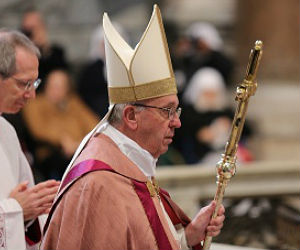
2015122258pope

Pope Francis at today’s Mass for Gaudete Sunday, via Catholic.org. The color is rose, not pink! Real men wear rose…

“Rejoice in the Lord always!”[1] Rejoice! During this Advent season, we have so many things for which we can rejoice: family, friends, celebrations, but do we remember the reason for which we should truly be rejoicing? My friends, that reason is, of course, Jesus Christ. As we proceed through Advent, we prepare for His coming, readying our hearts for the Nativity of our Lord. What a beautiful time of year this is!

At the same time, I think it can also be very difficult to rejoice, or at least to take the time away from our busy schedule in order to rejoice. Those same items I mentioned above for which we are joyful can hinder our focus on the real reason for joy. Preparing for family visits might have us running errands all over the place, or Christmas lists might have us focused on shopping. Or perhaps more serious concerns keep us from rejoicing… Maybe we have to choose between paying an electric bill and buying gifts. Perhaps there has been the death of a loved one. Or maybe the winter weather has put us in a depressed mood, despite the much needed rain and snow!

So how are we to rejoice then in this season? How do we reorient ourselves towards the true reason for rejoicing as we look expectantly for the coming of our Savior?

Well, one practical thing we can do is turn to others. In this season of Advent and the coming season of Christmas, it is important to remember those who are missing something, whether they are missing dry clothes, a hot meal, or the pleasure of family and friends. The Gospel today tells us that “whoever has two cloaks should share with the person who has none.  And whoever has food should do likewise.”[2] We shouldn’t leave Church and act as if nothing we do here has changed us. We must go out into the world and be a force for good, allowing the Lord to work through us in our words and deeds, showing those around us that “the Lord is near”[3] and he is ever-faithful in His promise to remain with us all the days of our lives.

There is another way we can reorient ourselves towards joy, more so than any of the other things I have mentioned thus far: simply turning to the Lord Himself. After all, how can we show others that the Lord is near if we do not first believe and act on it ourselves? For no matter what is going on in our lives, in the moments in which we rejoice or in the moments in which we might despair, we must recognize that the reason for our joy never ceases, as God has “a single motive for choosing”[4] us, for coming to us in the child Jesus, and that is His never-ending love for us to bring forth our salvation through that small child in the manger who will one day hang on the cross.

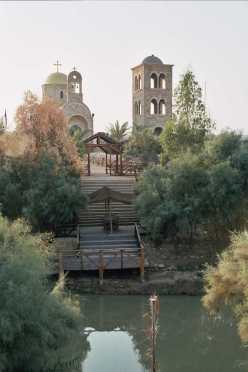
By Idobi (Own work) CC BY-SA 3.0 via Wikimedia Commons

By Idobi (Own work) CC BY-SA 3.0 via Wikimedia Commons

A voice crying out from the wilderness reminds us of this love, and the presence of the Lord in our lives. We hear it in today’s Gospel: while John was in the womb of Elizabeth, he foretold the coming of the Lord; now on the banks of the Jordan, he foretells the coming of Jesus once again, proclaiming that Christ will “baptize you with the Holy Spirit.”[5] In this baptism with the Holy Spirit, we are made a new creation and are truly given a reason to rejoice: we have new life in Christ and “can cry out with joy and gladness.”[6] He never ceases to call us, and in our baptism we find true life and happiness.[7]

Finally, not only do we have this enduring promise, but He makes it easier to attain joy and hope than we can possibly imagine: He comes to us, right here and right now. We don’t have to travel far, we don’t have to do anything complicated, we just need to turn to His love and mercy in the sacraments. In the Sacraments, “the Lord is in our midst”; in the Sacrament of Reconciliation, he renews us in His mercy, and in the Eucharist, He will renew us in His love. We only need to have confidence in Him.[8] Take advantage of the treasures He has given us in the faith, these tangible and real signs that echo the voice of John the Baptist as he cries out to us proclaiming the presence of the Lord.

My dear friends, in this season of Advent, on this Gaudete Sunday, we have a true reason for joy. As we look to His coming at Christmas, we find a hope and peace that no thing or person in this world can satisfy. Let us enter His infinite love, becoming signs of that love ourselves, and “Cry out with joy and gladness: for among you is the great and Holy One of Israel.”[9]


  • [1] Phil. 4.4
  • [2] Luke 3.11
  • [3] Phil. 4.5
  • [4] CCC 218
  • [5] Luke 3.16
  • [6] Responsorial Psalm Verse
  • [7] CCC 30
  • [8] Zeph. 3.17
  • [9] Responsorial Psalm Verse

Note: I am back after exams and the end of the semester. Thank you for the prayers!

First Sunday of Advent: Hope (Pope’s Homily)

In today’s homily for the First Sunday of Advent, Pope Francis reminded us that our salvation in Christ, at its core, is about justice, love, and the invincible power of God; in this we have our hope. With these thoughts, he opened the Year of Mercy at the Cathedral of the Immaculate Conception, located in Bangui in in the Central African Republic. The Jubilee of Mercy will be officially opened in Rome on the Feast of the Immaculate Conception, Tuesday, December 8.

The readings for today’s Mass can be found here. The homily in full:

On this first Sunday of Advent, the liturgical season of joyful expectation of the Saviour and a symbol of Christian hope, God has brought me here among you, in this land, while the universal Church is preparing for the opening of the Jubilee Year of Mercy. I am especially pleased that my pastoral visit coincides with the opening of this Jubilee Year in your country. From this cathedral I reach out, in mind and heart, and with great affection, to all the priests, consecrated men and women, and pastoral workers of the nation, who are spiritually united with us at this moment. Through you, I would greet all the people of the Central African Republic: the sick, the elderly, those who have experienced life’s hurts. Some of them are perhaps despairing and listless, asking only for alms, the alms of bread, the alms of justice, the alms of attention and goodness.

But like the Apostles Peter and John on their way to the Temple, who had neither gold nor silver to give to the paralytic in need, I have come to offer God’s strength and power; for these bring us healing, set us on our feet and enable us to embark on a new life, to “go across to the other side” (cf. Lk 8:22).

Jesus does not make us cross to the other side alone; instead, he asks us to make the crossing with him, as each of us responds to his or her own specific vocation. We need to realize that making this crossing can only be done with him, by freeing ourselves of divisive notions of family and blood in order to build a Church which is God’s family, open to everyone, concerned for those most in need. This presupposes closeness to our brothers and sisters; it implies a spirit of communion. It is not primarily a question of financial means; it is enough just to share in the life of God’s people, in accounting for the hope which is in us (cf. 1 Pet 3:15), in testifying to the infinite mercy of God who, as the Responsorial Psalm of this Sunday’s liturgy makes clear, is “good [and] instructs sinners in the way” (Ps 24:8). Jesus teaches us that our heavenly Father “makes the sun rise on the evil and on the good” (Mt 5:45). Having experienced forgiveness ourselves, we must forgive others in turn. This is our fundamental vocation: “You, therefore, must be perfect, as your heavenly Father is perfect” (Mt 5:48).

One of the essential characteristics of this vocation to perfection is the love of our enemies, which protects us from the temptation to seek revenge and from the spiral of endless retaliation. Jesus placed special emphasis on this aspect of the Christian testimony (cf. Mt 5:46-47). Those who evangelize must therefore be first and foremost practitioners of forgiveness, specialists in reconciliation, experts in mercy. This is how we can help our brothers and sisters to “cross to the other side” – by showing them the secret of our strength, our hope, and our joy, all of which have their source in God, for they are grounded in the certainty that he is in the boat with us. As he did with the apostles at the multiplication of the loaves, so too the Lord entrusts his gifts to us, so that we can go out and distribute them everywhere, proclaiming his reassuring words: “Behold, the days are coming when I will fulfil the promise I made to the house of Israel and the house of Judah” (Jer 33:14).

In the readings of this Sunday’s liturgy, we can see different aspects of this salvation proclaimed by God; they appear as signposts to guide us on our mission. First of all, the happiness promised by God is presented as justice. Advent is a time when we strive to open our hearts to receive the Saviour, who alone is just and the sole Judge able to give to each his or her due. Here as elsewhere, countless men and women thirst for respect, for justice, for equality, yet see no positive signs on the horizon. These are the ones to whom he comes to bring the gift of his justice (cf. Jer 33:15). He comes to enrich our personal and collective histories, our dashed hopes and our sterile yearnings. And he sends us to proclaim, especially to those oppressed by the powerful of this world or weighed down by the burden of their sins, that “Judah will be saved and Jerusalem will dwell securely. And this is the name by which it shall be called, ‘The Lord is our righteousness’” (Jer 33:16). Yes, God is righteousness; God is justice. This, then, is why we Christians are called in the world to work for a peace founded on justice.

The salvation of God which we await is also flavoured with love. In preparing for the mystery of Christmas, we relive the pilgrimage which prepared God’s people to receive the Son, who came to reveal that God is not only righteousness, but also and above all love (cf. 1 Jn 4:8). In every place, even and especially in those places where violence, hatred, injustice and persecution hold sway, Christians are called to give witness to this God who is love. In encouraging the priests, consecrated men and woman, and committed laity who, in this country live, at times heroically, the Christian virtues, I realize that the distance between this demanding ideal and our Christian witness is at times great. For this reason I echo the prayer of Saint Paul: “Brothers and sisters, may the Lord make you increase and abound in love to one another and to all men and women” (1 Th 3:12). Thus what the pagans said of the early Christians will always remain before us like a beacon: “See how they love one another, how they truly love one another” (Tertullian, Apology, 39, 7).

Finally, the salvation proclaimed by God has an invincible power which will make it ultimately prevail. After announcing to his disciples the terrible signs that will precede his coming, Jesus concludes: “When these things begin to take place, look up and raise your heads, because your redemption is drawing near” (Lk 21:28). If Saint Paul can speak of a love which “grows and overflows”, it is because Christian witness reflects that irresistible power spoken of in the Gospel. It is amid unprecedented devastation that Jesus wishes to show his great power, his incomparable glory (cf. Lk 21:27) and the power of that love which stops at nothing, even before the falling of the heavens, the conflagration of the world or the tumult of the seas. God is stronger than all else. This conviction gives to the believer serenity, courage and the strength to persevere in good amid the greatest hardships. Even when the powers of Hell are unleashed, Christians must rise to the summons, their heads held high, and be ready to brave blows in this battle over which God will have the last word. And that word will be love and peace!

To all those who make unjust use of the weapons of this world, I make this appeal: lay down these instruments of death! Arm yourselves instead with righteousness, with love and mercy, the authentic guarantors of peace. As followers of Christ, dear priests, religious and lay pastoral workers, here in this country, with its suggestive name, situated in the heart of Africa and called to discover the Lord as the true centre of all that is good, your vocation is to incarnate the very heart of God in the midst of your fellow citizens. May the Lord deign to “strengthen your hearts in holiness, that you may be blameless before our God and Father at the coming of our Lord Jesus with all his saints” (1 Th 3:13). Reconciliation. Forgiveness. Love. Peace. Amen.

H/T to Whispers.

Advent 2015 Resources

The Annunciation, by Murillo [Public Domain], via Wikimedia Commons

The Annunciation, by Murillo [Public Domain], via Wikimedia Commons

Let’s be honest: Christmas often overshadows Advent, especially in our increasingly secular society that tends to focus on the gifts rather than on the true meaning of Christmas (Archbishop Sheen will explain it all to you here). This year, however, try something different: try making Advent a priority in your house, taking advantage of this crucial piece of the Christian journey as we seek to grow closer to Jesus Christ.. I have put together some resources that I have tried in the past and found both encouraging and thought-provoking.

No matter what you do, however, don’t let Advent pass you by! Be intentional, prepare for the coming of Jesus at Christmas in a new and profound way this year by focusing on the season of Advent.

Bishop Robert Barron’s Daily Advent Reflections – Available in both English and Spanish, I have found these reflections a good way to start the day, often reading them as I drink a cup of tea before I get ready in the morning. On each Sunday, they are a bit longer, and sometimes include a video. Bishop Barron’s introduction is below.

Best Advent Ever – From Matthew Kelly and Dynamic Catholic, this is another great series on focusing on the meaning of Advent and how it can be truly meaningful and life-changing. Click through to see the introduction video.

An of Advent from Jimmy Akin and the National Catholic Register – Straight and to the point, this is a good thorough FAQ of sorts for Advent.

Reflections on Advent, related devotions, as well as other resources, from EWTN – There is a lot of great info on this site, but it can be a bit difficult to navigate at first. If you are looking for the weekly reflection, they are at the very top of the page.

Resources from the USCCB – this site includes reflections and prayers on the meaning of Advent, a guide for how to set up an Advent Wreath, and even an electronic Advent Calendar

Historic and Symbolic Meaning of Advent from the Catholic Encyclopedia – Pretty self-explanatory. It’s an encyclopedia article on Advent.

For my own part, I will be posting weekly reflections as well, in addition to any other helpful items or articles I might find over the next few weeks.

Make this year’s Advent purposeful. Know that my prayers are with you all; please keep me in your prayers too!

UPDATE (11/27/15 14:58): A friend of mine just sent me a really cool “Names of Jesus” Advent chain activity. There are 25 names, so you can start on December 1st with your kids. An excellent way to learn about Jesus and enter into the season of Advent!

On the Journey: Childhood

Augustine’s Confessions I.7-12

“You are the one and only mold in which all things are cast and the perfect form which shapes all things and everything takes its place according to your law.” -Confessions I. 7

One of the most profound experiences that one can have, in my opinion, is holding a newborn child in their arms. The beauty and innocence in the eyes of an infant can reach a person to the very soul, putting him or her in touch with the God who created us all, who at one time formed us in the womb so that we might be held by our own fathers and mothers.

The parent of a toddler running around the house may not be so keen on seeing that innocence, and the parent of a teenager may outright deny it!

We are all born in this wonderful state, but then again, we are also human. We are not born perfect, and we will grow to make mistakes, fall, both proverbially and actually, and by God’s grace, we will get up again.

I remember when I was a young child, probably middle elementary school and I was out playing with some friends. I did not want to come home, only because I wanted to play longer, and ignored the calls of my mother. (And when I say calls, I mean verbally, from the front porch. Well, whistles actually. Cell phones weren’t so common then. Man, I feel old all of a sudden…)

This obviously didn’t end well.

From Wikimedia Commons - Unlimited License

From Wikimedia Commons – Unlimited License

She kept calling, and I kept ignoring, and finally it came time that I had to leave my friend’s house so he could eat dinner. I proceeded out his front door, said goodbye, and waited. And hid behind a rather large bush. And waited some more. I mean, I knew I was in for it, so why not, right? I saw my mom ride by on her bicycle, looking frantically for me. I’m not sure how long it had been; it seemed like hours, but it was probably only 15 or 20 minutes. Eventually, I knew I had to make my presence known, and so I stepped out so she could see me.

That was the first time I experienced what it was like to be grounded.

Lord knows it wouldn’t be the last, and that I have probably given my mother and father a fright or two or ten since then!

But my point is this: even at that young age, we struggle with the right thing to do, what choices we make, and this is where we find Augustine in this week’s reading. He recounts what he must have been like as an infant (whiny) and what he was like during his early school years (a brat who didn’t want to concentrate on school work):

“I was disobedient, not because  I had chosen something better than they [my parents] proposed to me, but simply from the love of games…My eyes shone more and more [with curiosity]…[and I] wanted to see the shows and sport which grown-ups enjoyed.” –Confessions I.10

The Carpenter's Shop, by Everett Millais [Public domain], via Wikimedia Commons

Somehow, I don’t think our Lord ever got in trouble… Painting entitled “The Carpenter’s Shop”, by Everett Millais [Public domain], via Wikimedia Commons

Augustine sought to follow his own desires, seeking what he considered the “wealth of this age” (I.9). But even at this point in life, even though he  had a lot of growing up to do, and many more mistakes to make, he still had an inclination of the presence of God, taught  to him by his mother Monica.  At one point, he even pleads with his mom, appealing to her own devotion, “Give me the baptism of Christ your son, who is my God and my master” (I.11).

I wish I was as eloquent as Augustine at that age!

There is a two fold lesson that we can learn from our own lives and from Augustine in all of this. First, we must grow up. Second, we must remain children. Scripture even supports this: in the Gospel of Matthew, Jesus Christ tells his followers, “Truly, I say to you, unless you turn and become like children, you will never enter the kingdom of heaven. Whoever humbles himself like this child, he is the greatest in the kingdom of heaven” (18.2-4). In one of the Apostle Paul’s letters, he speaks of “put[ting] away childish things” (1 Cor. 13.11).

Of course there is no contradiction here. In one sense, we must strive to return to the humility of childhood, seeing ourselves how God sees us, trying to better ourselves, get aways from the distractions of the “wealth of this world.” We must seek refuge in Him as the Father that He is, accepting the mercy of His Son, allowing the Spirit to penetrate our hearts. At the same time, this movement of child-like faith and humility will cause us to grow up, to see the world how it truly is, to see the emptiness of worldly wealth and to see how His truth and beauty permeates all things. We discover that we can either allow ourselves to be swept away by that beauty, or turn our backs on it as we would a cold wind.

The Father has cast us in His image; let’s rediscover the mold from which He made us as little children.

For reflection:

How can you become more like a child to grow closer to God?

What things do you need to put away in order to grow closer to God?

Up in two weeks: Confessions I.13-15. Normally I try to post weekly, but I am taking this short hiatus to focus on enjoying vacation and studying for finals. There will be other posts on the blog before then, I am sure, but the next one in this series will be on Dec. 9.

This is part of a continuing series, Companions on the Journey. You can take a look at previous posts in the series or read the introduction.